If You Pluck a String on a Guitar and Then Push Down on It and Pluck It Again Do You Usually Get
Harmonics are played every time y'all pluck a note. Nearly of the fourth dimension, however, you practice non hear them. What yous hear is the fundamental (sometimes chosen the first harmonic). The fundamental is the loudest sound produced, but it is accompanied by several harmonics. "Playing harmonics" on guitar is actually playing "artificial harmonics." Basically, information technology is a style of eliminating the fundamental and the other overtones. It produces a nice effect that many guitarists similar to use. There are several ways to play these.
Open-String Harmonics
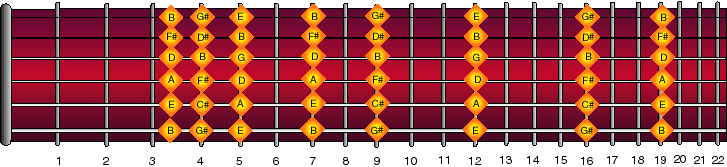
Open-string harmonics are sometimes referred to as natural harmonics. To play open-string harmonics, y'all can place your finger lightly on the string in the places shown in the diagram below. Do not press the string down. It should not touch on anything only your finger. By doing this, you lot will play the notation shown in the diagram over the given expanse.
Fretted Harmonics
Playing fretted harmonics can be hard at times. This requires the fretting of a note, plus a "soft bear upon" on a string which is exactly 12 frets above the note you are fretting. In addition to this you must still pluck the string. To do all three of these tasks at once, you must combine the tasks of the "soft touch" and the plucking of the string. There are 2 techniques of doing this.
Technique i: Artificial Harmonics
Although all harmonics that y'all play are actually artificial harmonics, this technique is normally referred to as playing an artificial harmonic. This technique requires that you lot "soft touch" with your index finger and then pluck with your pinky finger or a pick held in the other fingers. The other technique is playing a pinched harmonic which is more difficult to learn only volition allow y'all to play fretted harmonics more quickly once it is mastered.
Technique two: Pinched Harmonics
This is a difficult technique to master. Consequent playing of pinched harmonics crave that you use a modified picking technique along with a steady and accurate picking hand. The showtime thing that you must master is how to hold the pick and pluck the string. You lot hold the pick by having the pick barely clear the bottom of your thumb. The key is to pluck the string with the pick merely have the thumb immediately hit it to produce the harmonic. This pick and thumb should hit the string nearly simultaneously.
You must also know where to pluck the string. If you do not hit the "sugariness spot" on the string it will sound like a muffled note. The platonic place to pluck depends on where your thumb produces the harmonic. Your pollex should striking the cord half style between the span and the the fret that you are playing on. So when you play on dissimilar frets, you must also pluck in different places. This makes it a lilliputian harder to play.
Notation: There are other sugariness spots as well. The sweet spots are proportional to the length of the string. When y'all play open up-string harmonics, there are several places that produce harmonics. These are the "sweet spots" for a full length string (open up string). When you fret a annotation, all the "sweet spots" stay in proportion to the string length, which is the length from the fret you are playing to the bridge. Therefore, several "sweetness spots" be for both open-string and fretted harmonics. The 1 matter to remember is that they are not all one octave higher then hitting alternate "sweet spots" will play a different notation.
The Physics of Harmonics
Did yous e'er wonder why a harmonic is produced? It'southward quite elementary actually. It is a affair of string length. When you use your finger to produce a harmonic, you change how the string vibrates. When playing open string harmonics, you split the string into halves, thirds, fourths, fifths, and sixths. So playing the harmonics at the twelfth fret split the string in half. Playing at the 7th or 19th fret split the cord into thirds, and and then on. You lot volition as well find that playing harmonics at the 7th or 19th fret are exactly the same notes. You can besides divide the guitar into fourths at the 5th fret or the 24th fret (or where the 24th fret would be if you lot don't have that many frets). Once again, harmonics at the 5th and 24th frets produce the exact same notes. Notice that the 12th fret isn't included considering that splits the string into halves (larger subsections of the string).
So how does it work? Your finger acts as a pivot point for the cord by forcing the string to vibrate in halves, thirds, fourths, etc. This cuts the wavelength in half, thirds, fourths, etc. Wavelength determines what the frequency of a note is, and frequency determines what note you are playing. Did you always hear someone say to tune to A at 440? The 440 represents the frequency of the A note at the 1st string at the fifth fret. If you double that frequency, you lot will play an A that is an octave college. This too cuts the wavelength in half. Y'all might be able to see the relationship between frequency and wavelength. Frequency is inversely proportional to wavelength. This basically means that wavelength = 1 / frequency. In other words cutting wavelength in one-half with double the frequency, and cutting the wavelength into 1/3 volition triple the frequency.
So why do all my strings brand different sounds even though they are the aforementioned length? This occurs due to the tension on the string. Basically the tension of the string modifies how the string vibrates so that it has a different frequency. When you lot accommodate the tension, y'all also change the bore of the string. Stretching or tightening the string makes the diameter smaller.

barnettkimmilloof.blogspot.com
Source: https://www.guitarlessonworld.com/lessons/harmonics/
0 Response to "If You Pluck a String on a Guitar and Then Push Down on It and Pluck It Again Do You Usually Get"
Postar um comentário